Saturday, June 15, 2013

Lalee: Black Feet

This week, in my never-ending effort to be well-integrated in my community, I turned the soles of my feet black with a product called lalee (this spelling is approximative). In my community, black soles are a way of enhancing your beauty. The product has a similar effect to henna (ie, it temporarily dyes your skin), but the substance itself is different.

There are two forms of lalee in Benin. There is the traditional lalee, which I selected, and also a new version which is called lalee Yayi Boni (named after Beninese president Yayi Boni).

The traditional lalee comes in two parts. First, you mix a green powder with water and apply the paste to your skin. Ideally, you will leave this on for at least three hours and repeat the process multiple times. The green paste will dye your skin red. To make sure that your dyed soles have very clean lines, electrical tape is used to define the area to be dyed, much like painter's tape and plastic tarp keep you from painting your baseboards when painting a wall.

Lalee. The paste in the bowl is ready to be applied to my feet. The green powder in the plastic baggies is for the next round. The small baggie on the left contains the crystals that will help turn my red soles black.
My sole is orange from the last round of lalee that we applied, but we are adding another round to make it even darker.
Once your lalee is deep red, you apply the second part. For this step, you mix a crystal powder with water and ashes or cement, then apply it to your feet. You let this sit for 20-30 minutes before removing. Any place that had been deep red before will turn black.

Applying the cement-crystal mix that will turn my red soles black
However, if your sole was not deep red, the black will not come in properly. On my first attempt, the red color did not set in very well, so I ended up with red soles with black spots like leopard skin. The next attempt produced a similar result. For my third attempt, my friend decided that I needed to wear the green paste overnight to make sure that the red color set in well. She applied it for me at 9 pm, then sent me home with plastic bags around my feet. I slept with those plastic bags, then removed the green paste. She had me do another round of green paste (three hours to set in), then the final step to turn it black, and voila! I have black soles.


Success!

Saturday, June 8, 2013

School in Sonsoro

Every week, I do health lessons in three local elementary schools. Since school is almost out for summer, let me give you a glimpse of what a Beninese classroom is really like.

As soon as I enter the classroom, the 50-70 students stand up and greet me in unison, then respond in unison to my greeting. Next, before we start our actual lesson, the teacher calls on a student to pick a song, and all the students sing the song together. Once the lesson begins, we proceed very slowly. School is conducted in French, but most of the children did not know any French before starting kindergarten, so it is the Beninese equivalent of having a room full of ESL students. As a result, we have to constantly rephrase our questions and check for comprehension.

To be called on, a student raises a finger in the air and says, “Here! Here!” When a student gives a particularly good answer, he is rewarded with rhythmic clapping. That is, the teacher gives the signal, and the whole class claps a certain pattern to congratulate the student. When a student gives a wrong answer, the teacher never says the answer is wrong, but instead asks the students, “Who can give a better answer?”

All of the students wear uniforms, which are called “khakis” because they are all made of a khaki- colored material. Girls are expected to shave their heads for fear that extravagant hairstyles could be distracting in class. The uniforms and shaved heads makes it easy to recognize which children go to school. Ultimately, only a minority of local children are enrolled, mostly because the other parents do not understand the importance of school or do not have the means to send their children. Between tuition (only boys pay), school fees, uniforms, and supplies, educating a child is expensive.

I always make up a song to teach the kids in order to help them remember the key message of our lesson. When the kids learn the song, I know that even if they forget everything else I taught them (or perhaps they did not truly understand because of their French level), they will at least retain the key message. Plus, singing is such a part of Beninese school culture that my song is a perfect fit. Even if I did not teach them a song, they would sing one at the end of the lesson before I left.

So to conclude this blog post, let me share a song with you:

Je bois de l'eau potable
pour la bonne sante.
Et je couvre bien la jarre
pour la proteger.

(“I drink potable water so that I'll stay healthy. And I make sure to cover the water jug so that the water stays clean.”)


We sing this song to the tune of “Row, Row, Row Your Boat”. Now if only I could get them to sing it in a round!

Saturday, June 1, 2013

Bariba in Sonsoro

Since the upcoming end to the school year means I will have significantly more free time, I finally hired a Bariba tutor to teach me the local language. I discovered that one reason I have struggled to pick up Bariba on my own is that almost everything here is different from the Bariba I learned in Dangbo, where I was taught the “standard” Bariba spoken in Parakou and Nikki. There are so many differences between the two that it is as if I am being expected to speak Portuguese after having taken a semester of elementary Spanish.

Here are some examples:

Good morning: 'a kunando' in Sonsoro instead of 'a punando' elsewhere
Good afternoon: 'ka sonhon' instead of 'ka sonson'
How are you?: 'anna wahi?' instead of 'anna wasi?'
What's your name?: 'anna wen yisiru?' instead of 'amona wunen yisiru?'
My name is...: 'nen yiha...' instead of 'nen yisiru'
Morning: 'bude' instead of 'bururu'
How much?: 'yea?' instead of 'n'yewa?'
Market: 'yowo' instead of 'yoburu'
Work: 'soru' instead of 'soburu'
Father: 'tuno' instead of 'baa'
Teacher: 'metu' instead of 'metiri'
Foot: 'kona' instead of 'nasu'
5: 'no' instead of 'nobu'
10*: 'wogu' instead of 'wokuru'
16: 'woganogatia' instead of 'wokuranobatia'
18 (age): 'yendu yiru seri' instead of 'wokuranobaita'

(*Nearly every single number after 10 is different in Sonsoro from standard Bariba.)

As you can see, many of the differences are small, but since so many words are different, especially key words, the effect is that nearly everything I try to say is just a little bit wrong.

Ultimately, Bariba is an intensely localized language. Each village puts its own twist on the language, and even nearby villages do not quite speak the same Bariba we speak in Sonsoro. The “true” Bariba, or standard Bariba, is the Bariba spoken in Parakou (the largest Bariba city) or Nikki (considered the heart of the Bariba region). There have been some efforts to codify Bariba in books and dictionaries and to spread standard Bariba to villages like Sonsoro. During the dry season, a Swiss NGO sponsors language classes in Sonsoro to teach the villagers how to speak and read/write French and how to read and write standard Bariba.

In closing, I would like to impress upon you the challenge that lies ahead of me by showing you how to say 999 in Bariba:
wonoosunobainegawenegawoguganogaine.


Now say that three times real fast!

Saturday, May 25, 2013

How Old Are You?

Last night, a village friend told me about his great-grandmother who died a few years ago at 140 years old. His grandmother, he said, is 100 and his mother is 70. I naturally found this hard to believe, especially since his mother would have thus been 52 years old when she gave birth to her youngest child.

These astronomical claims of age are quite common in Benin. Another friend was unimpressed when I told her about a 94-year-old grandmother in the US; she said her husband's grandmother lived to be 120. One of my colleagues prints memorial t-shirts for people who have died, and it is not common to see t-shirts for couples where the wife died at 110 and the husband at 120. The televised obituaries are also full of centenarians. In western Benin, I even saw a tombstone claiming that the deceased had died at 242 years old!

In reality, most Beninese, especially the older generations, have no clue when they were born. To determine a person's age, you just eyeball it: that person looks really old, so he must be 100! Hence, they chronically overestimate their age. That must be even easier to do when everyone else is claiming to be 120.

These days, however, children and young adults often know their real age because births are now recorded and birth certificates are issued. Some children who started school late or fell behind even have fake birth certificates with fake ages to allow them to pass school completion exams that are normally capped at a certain age.

Still, even though births are supposed to be registered, every week I weigh babies with no date of birth recorded in their health booklets (which is a problem since I use a malnutrition chart that compares weight to age). When I ask the mother to tell me her child's date of birth, she often does not know. Sometimes she can estimate, saying that the child is two weeks old or two months old, but often we have to proceed by using holidays as landmarks. Was your child born before or after Christmas? Was your child born before or after Tabaski? Was your child born before or after Ramadan?

As you can imagine, birthdays are not significant here since few people know when they were born. Even one of my friends who does know her date of birth told me that as a Muslim, she does not celebrate her birthday. And the one birthday that is celebrated every year as a national holiday, that of the Prophet Mohammed, changes dates each year since it is based on the lunar calendar. Of course, Christmas (Jesus' birth) is also a national holiday, and it is always celebrated on December 25.

In any case, maybe I should just take it as par for the course that the few Beninese people who have estimated my age pegged me for older than I actually am. Still, it feels somewhat remarkable because Americans chronically underestimate how old I am. Or maybe I am just aging dramatically! I should use more sunscreen...

Monday, May 20, 2013

Mango Season

As the end of the hot season approaches (I hope!), I am enjoying the one major perk that this season has to offer: mangoes. When mangoes started coming out a couple of months ago, they were expensive: five cents a piece for small ones, and as much as 60 cents for the biggest ones. Today, however, mangoes are so ubiquitous that I simply cannot understand why some people continue to pay for them. Mango trees are everywhere, so if you do not personally have one, your family and friends surely will.

I have been given many mangoes from friends and colleagues, and I have also been bringing mangoes back from the mango tree at the volunteer house in Kandi. Last Sunday, I brought back 60 or so mangoes, another 30 on Thursday, and yesterday's haul netted me more than 40. I have been taking advantage of the abundance of mangoes to try various mango preservation techniques: mango sauce, dried mangoes, jam, etc.

Of course, I have been eating plenty of mangoes the normal way as well. On many days, I eat nothing but mangoes until dinner. While I can comfortably eat ten mangoes in a sitting, last week I learned the hard way (ie, vomiting) that 13 is too many at one time.

Now, before you mango lovers out there get too jealous, remember that this abundance of mangoes only comes during the hot season. In Sonsoro, that still means temperatures in the 110s with no electricity and thus no A/C, no fans, no cold drinks, and no ice cubes. But plenty of delicious mangoes.

A mango tree
The morning's haul

My homemade mango jam


A mango smoothie, courtesy of the volunteer house blender in Kandi


Saturday, April 27, 2013

Palm Oil

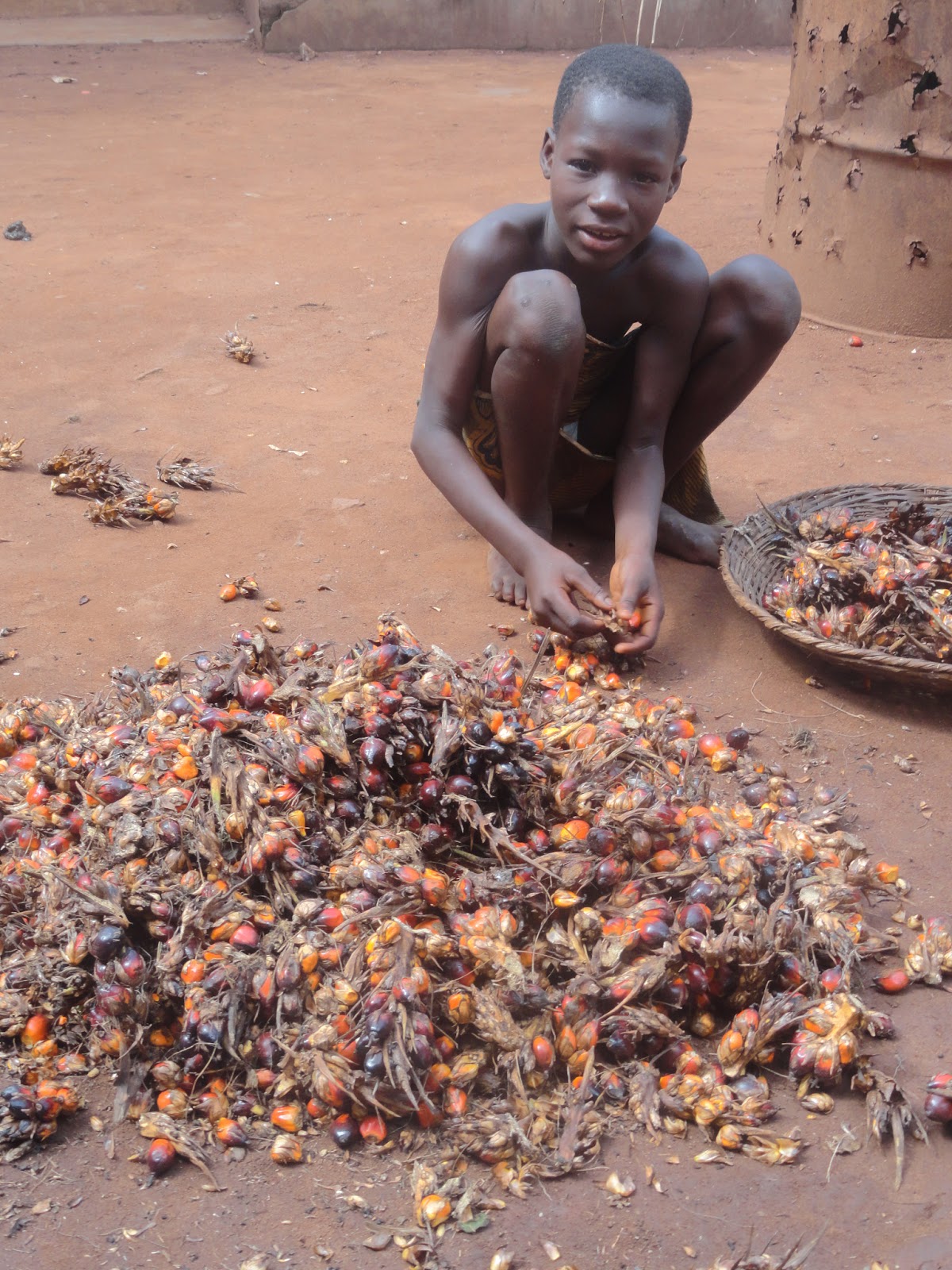
One of the top agricultural products of the south is palm oil, also known to the Beninese as red oil. It is common in southern Beninese cuisine, whereas it is rare in the north due to the lack of palm trees. Peanut oil is the oil of preference in the north.


The palm clusters are removed from the trees, then the "berries" are removed from the clusters. Watch out for the thorns!
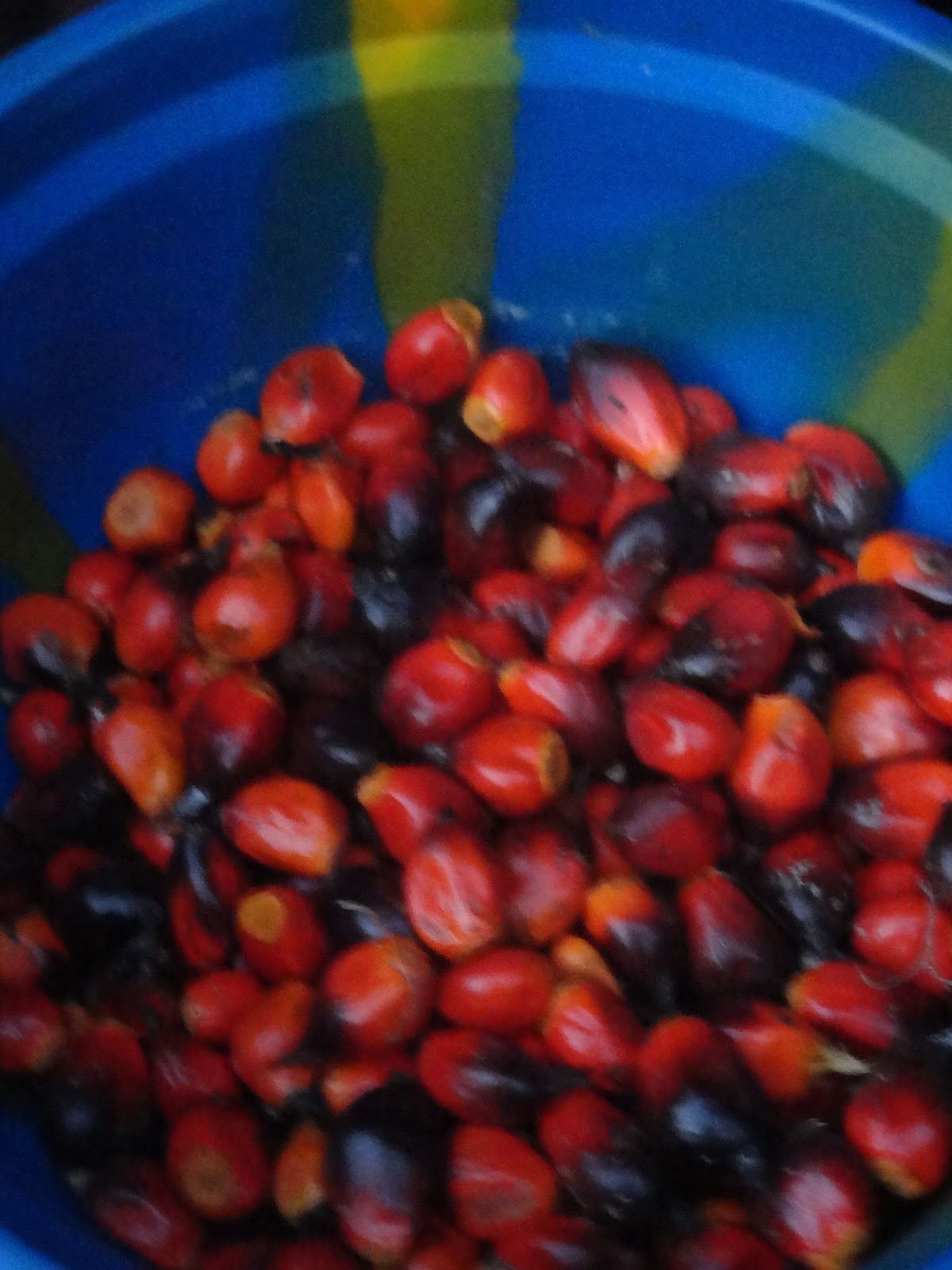
The palm "berries", ready to be pressed into oil
Oil packaged in a recycled plastic container. Time to make some beans!

Tuesday, April 23, 2013

Women's Rights in Benin (Part III)


The final installment on women's rights:

Marriage

By law:

Forced marriage is illegal. A woman has the right to choose her own husband. If she is married before she turns 18, the marriage is considered to be a forced marriage, whether or not she gave her consent.

Furthermore, polygamous marriages are not allowed under Beninese law.

In practice:

I do not have a clear idea of how many women are forced into marriage in Sonsoro, but it is common in Benin. Many women, however, are married before age 18. For example, last summer, my 40-something-year-old colleague took a 17-year-old wife (who is in sixth grade), supposedly with her consent after the parents proposed the marriage. While such illegal marriages are common in my area, complaints about such marriages are rare.

As for polygamy, it is the norm rather than the exception in my area. However, it is exceptionally rare for a couple, especially in Sonsoro, to have a state-recognized marriage. Most marriages are religious or simply traditional.


Children

By law:

Women have a right to birth control, and the government encourages health centers to discuss family planning. Previously, abortion was only allowed in the case of rape, incest, or danger to the mother or child and only when the need had been certified by the courts. Now, abortion is illegal in all cases.

In practice:

In Sonsoro, our health center only does about 5% of the family planning consultations the government expects us to do. The health center will not sell or administer birth control to a woman without her husband's consent. Husbands rarely allow their wives to be on birth control because they believe that only the fear of pregnancy keeps their wives faithful to them. Also, children are considered a man's wealth, so he has an incentive to produce a large family.

One case that struck me was when a woman came to our health center with her husband to have a pregnancy test. She had a young baby on her back and the pregnancy test was positive. I asked the nursing assistant if she was going to talk to the couple about birth control since they were having children so close together (we generally recommend birth spacing of 2-3 years between children). The nursing assistant explained that the husband refused to put his wife on birth control and wanted her to get an abortion. He would rather abort unwanted pregnancies than allow his wife to take birth control.

On the subject of abortion, some middle school teachers estimated yesterday that at least a third of their female students had had an abortion at some point. Since abortion is illegal, these clandestine abortions are extremely dangerous.

As for child custody in the case of divorce, the traditional practice is that the man gets custody and the children will be raised by one of his other wives. Therefore, when a woman wants to escape an abusive relationship, she may have to choose to sacrifice her children.


Female Genital Mutilation

By law:

Female genital mutilation is illegal in Benin.

In practice:

Female genital mutilation still exists in certain parts of Benin, particularly the northwest. I have never heard of it being practiced in Sonsoro, but one of my work partners pointed out the tree under which it used to be done. He said it was very common 20 years ago but that he no longer hears of it being practiced in Sonsoro. In all of Benin, 30-50% of women have been subjected to female genital mutilation, according to one estimate.